Agenie vs Polar Analytics
Agenie reads your business and tells you what to do. Polar hands you a governed data platform and pipes it into the AI tools you already use, so you can go and ask. Here is the honest, side-by-side version.
No credit card required · Free for 30 days · See pricing
Agenie makes the call inside the product: every board opens with what moved, why, and the action to take, grounded in a governed model and a causal framework.
Polar hands you the data and a pipe to your own AI tools. The right question, in the right tool, is still yours to chase.
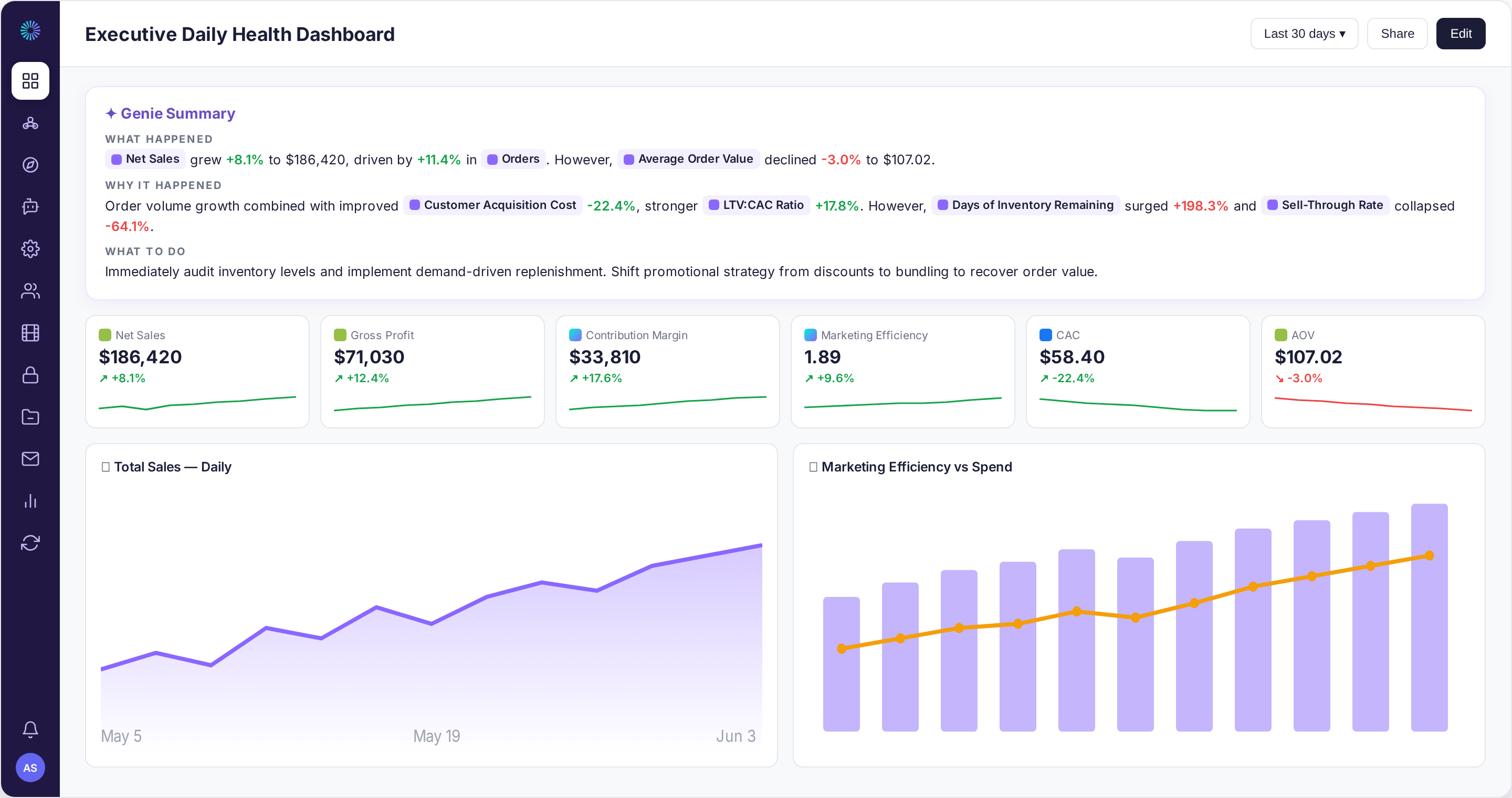
Built to run your whole business, not just your ad account.
Agenie does not just report your numbers. It diagnoses what is happening, helps you manage it, and proposes the fix, across every part of your business.
Every answer is built on the Metrics Map, a framework that gives each KPI a job, and tuned to your business with Genie Context, so the analysis fits how you actually operate, not a generic DTC template.
Agenie vs Polar Analytics, side by side
| Agenie | Polar Analytics | |
|---|---|---|
| Primary focus | Decision intelligence across the whole business | Marketing and acquisition analytics, plus whole-business reporting |
| Reads the business for you: what moved, why, what to do, on every board | ✓ | Ask Polar answers on request; proactive agents run in external tools |
| Signals, Drivers, Outcomes causal framework | ✓ | Governed metrics, not a causal tier framework |
| Right-click any metric for an in-product deep-dive (Ask Genie) | ✓ | Ask in your chat tool, not on the metric |
| Governed ecommerce semantic layer | ✓ | ✓ |
| Plain-language business context | Yes, company, team and per source | Yes, a custom data layer |
| AI works out of the box, no setup, no second tool | Genie built in, ready at login | Ask Polar in-app; agent suite and MCP run in Claude, ChatGPT and others you set up |
| Builds a full board from one plain-English prompt | ✓ | Dashboard library; Ask Polar generates reports |
| Connectors | Core DTC stack | 45+, including Amazon and NetSuite |
| Pixel attribution and Lifetime ID | Blended KPIs, not pixel attribution | ✓ |
| Incrementality testing | ✗ | ✓ |
| Separate paid products to unlock capability | No, Genie included | Incrementality, data activations and the MCP layer priced separately |
| Pricing model | Flat tiers, not GMV-based | GMV-banded, plus modular products |
| Setup | Minutes, no data team | 1-click, no engineering |
Why you can act on what Genie shows you.
You act on these answers, so they have to be right. Both Agenie and Polar define their metrics in a governed layer, so the raw numbers are solid on either side.
Polar's grounding stops at the metrics. Above them a general model in Claude or ChatGPT reasons freely, so ask it the same question twice and you can get two different answers, with nothing to tell you which to trust.
Agenie grounds Genie to three layers, not one: the governed metrics, the Signals, Drivers and Outcomes chain that orders the diagnosis, and your Business Context, the targets and rules you set. Ask it the same question twice and you get the same grounded answer.
Polar grounds the numbers. Agenie grounds the decision.
Ecommerce semantic layer
300+ governed metrics with one definition everywhere. Genie cannot quietly invent a number or redefine MER mid-answer.
Signals, Drivers, Outcomes
Every metric sits in a causal chain. When an outcome moves, Genie checks the drivers, then the signals underneath. That diagnostic order is built in.
Your business context
Your CAC targets, margin guardrails and peak periods, set in plain language across company, team and each source. Genie reasons within your rules.
The difference, in practice
An illustrative example of the same week, read two ways.
Before you ask, the Genie Summary on your board flags it: Meta ROAS down 12%, but blended CAC is flat and LTV:CAC is still healthy. It is creative fatigue, not a spend problem. Refresh the creative before you cut budget, and watch Add-to-Cart Rate as the early warning.
Ask Polar, and it returns a clean report: Meta ROAS is down 12% this week. Good answer, but you had to know to ask.
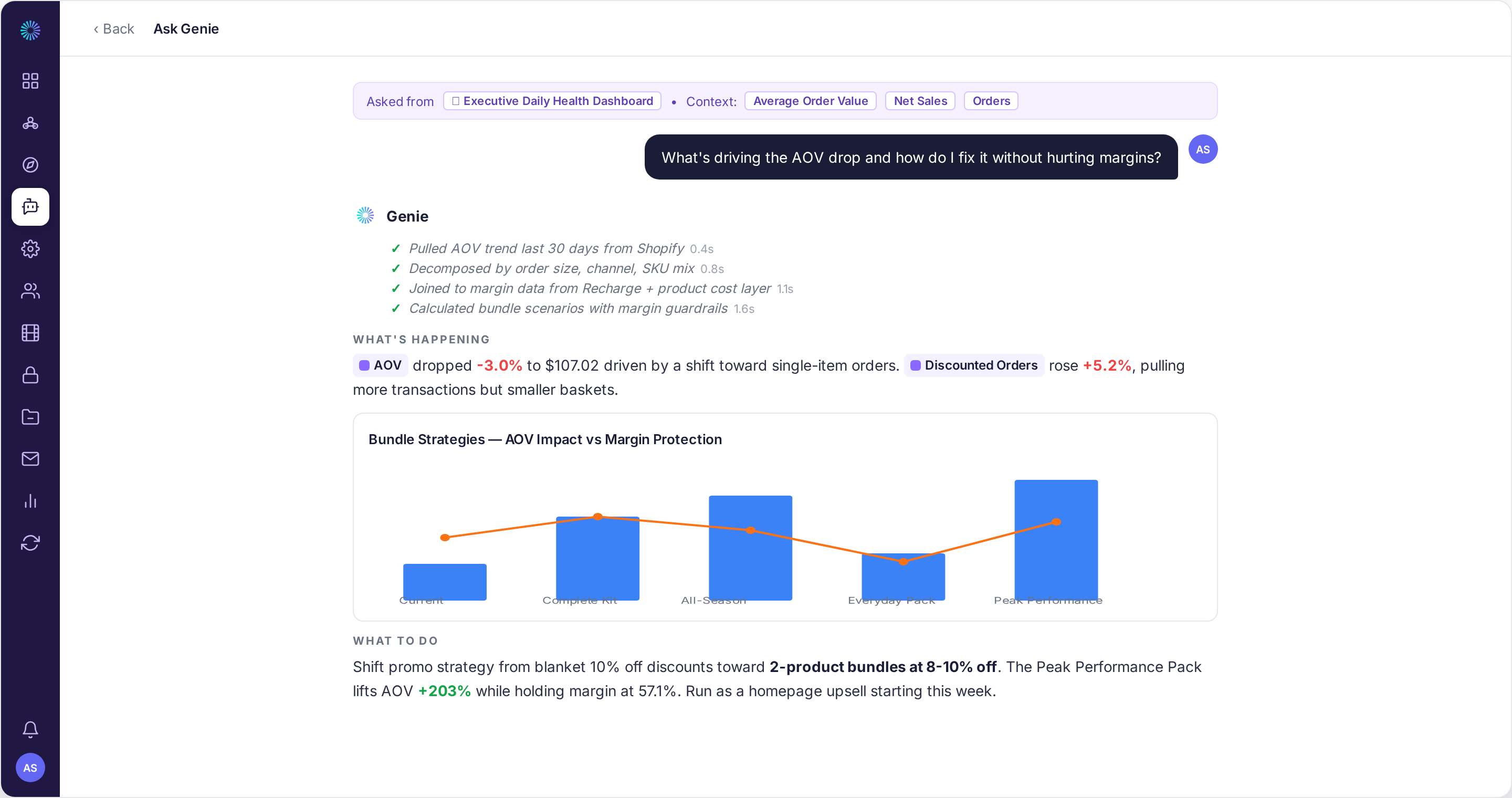
Polar hands your data to AI. Agenie hands you the decision.
Agenie reads the business and tells you the move. Open a board and the Genie Summary is already there: what changed, why, and the action to take, with no prompt to write and no second tool to open. Right-click any metric and Ask Genie deep-dives it in place. Getting AI onto your data in Polar is a setup job. You add an MCP connector, authorize it, point it at Claude or ChatGPT, and for a new account wait up to a day for the first sync. From then on the asking happens in that other tool, not in Polar, so you are flipping between the platform that holds your data and the chat window where you query it. Polar even badges Claude as "3x better" than the other tools you can connect, which tells you the answer quality rides on which model you bring. Agenie has the AI built in the moment you log in. One product makes the call. The other is a connector to set up and a tab to keep flipping back to.
One focused product, not a platform plus a stack of add-ons.
With Polar, the analytics is the base, and incrementality testing, data activations and the MCP layer are separate products you add, priced by your GMV. It is flexible, but the bill and the setup grow with it. Agenie is one product at a flat price. Connect your stack and Genie is there on day one, reading the business and recommending the next move, with no modules to assemble or tiers to climb.
A causal framework, not just a metric catalogue.
A governed semantic layer is table stakes now, and both products have one. What you do with it is the difference. In Agenie every metric has a fixed place in a Signals, Drivers and Outcomes chain, so when an outcome moves Genie walks the drivers, then the signals underneath, in that order. The diagnosis follows cause instead of whatever a model happens to surface. That structure is what lets Agenie hand you the why and the what-next, not a catalogue of correct numbers you still have to read yourself.
Built to run the whole business, not just the marketing engine.
Look at where Polar is deep: attribution, incrementality testing, a tracking pixel, creative analysis, a media-buyer agent. Like Triple Whale, its gravity is acquisition and paid media. It reports on profit, inventory and retention too, but that is dashboards, not where it diagnoses and recommends. Agenie is built the other way round. It reads the whole business as one story, marketing spend, inventory and merchandising, logistics, customer service, retention and profit, then tells you what to do across all of it, not just the ad account.
 Jacob Foy, Founder, Victory & Innsbruck
 “Instead of spending hours digging through reports, we can ask questions and quickly understand what is driving performance and where to focus.”
When Agenie is the clear choice
- You want the decision made in the product, not a data layer you point your own AI tools at.
- You want a guided, causal read of what changed and what to do, every morning, without remembering what to ask.
- You are a lean team that does not want to wire up MCP, pick agents, or manage a modular stack.
- You want flat pricing that does not climb with your GMV.
When Polar is the better choice
Polar is built for teams that want to pipe governed data into their own AI stack:
- You need 45+ connectors, including Amazon, NetSuite or true omnichannel and multi-store data.
- You want pixel-based attribution with Lifetime ID, or incrementality and lift testing.
- You are an agency or a larger team that wants to pipe governed data into your own ChatGPT, Claude or Slack workflows via MCP.
- You want to build and run your own AI agents on top of your data.
What a $10M GMV brand pays
The same whether you do $1M or $10M, because Agenie does not charge on GMV. Genie's AI is included, with no separate products to bolt on.
Polar prices by GMV band, so the bill rises with your revenue, and the MCP layer, incrementality testing and data activations are priced separately on top.
Polar figure is its own published pricing for a $10M GMV brand. Agenie figure is the published Growth plan, billed monthly (about $950), and does not change with GMV.
Common questions
Is Agenie a Polar Analytics alternative?
Yes, for brands that want the decision made inside the product rather than a data platform to connect their own AI tools to. If your priority is a broad data layer feeding ChatGPT or Claude via MCP, or deep pixel attribution and incrementality testing, Polar is purpose-built for that.
Do both have a governed semantic layer?
Yes, both do. The difference is what runs on top: Agenie adds a Signals, Drivers and Outcomes causal framework and a proactive Genie Summary that reads the business for you, so you get the why and the what-next, not just governed numbers to query.
Does Agenie connect as many sources as Polar?
No. Polar integrates 45+ connectors, including Amazon and NetSuite. Agenie focuses on the core DTC stack and goes deep on turning it into decisions. If breadth of raw connectors is your main need, Polar leads there.
Does Agenie do pixel attribution or incrementality testing like Polar?
No. Agenie uses blended, cross-source KPIs to diagnose the whole business rather than pixel-based attribution, and it does not run incrementality tests. Polar offers a first-party pixel, Lifetime ID and lift testing. The two approaches answer different questions.
How does pricing compare?
Agenie is flat, from £349/mo, priced on usage rather than GMV, with Genie included; the full breakdown is on our pricing page. Polar is GMV-banded from around $300/mo, and the AI layer, incrementality testing and data activations are separate products on top, so the cost grows with your GMV and your stack.
See what moved, why,
and where to act next.
Connect your stack and get your first answers in minutes.
No credit card required · Or book a demo