Agenie vs Triple Whale
Agenie tells you what moved, why, and where to act next, across your whole business. Triple Whale tells you where your sales came from. Here is the honest, side-by-side version.
No credit card required · Free for 30 days · See pricing
Agenie answers the three that actually run your business, what moved, why, and where to act next, across the whole business and grounded in governed metrics.
Triple Whale answers one question very well: where did this sale come from?
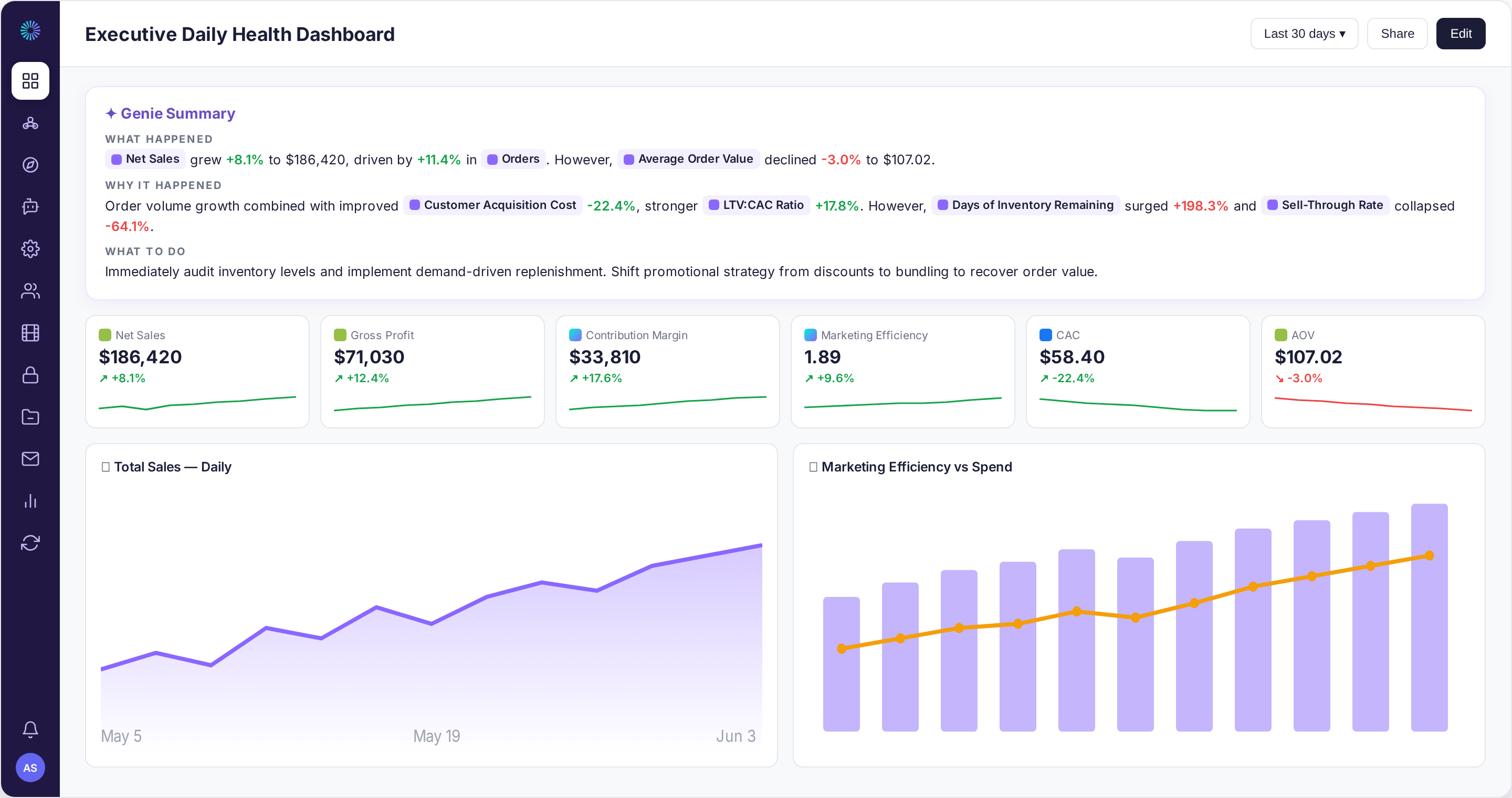
Built to run your whole business, not just your ad account.
Agenie does not just report your numbers. It diagnoses what is happening, helps you manage it, and proposes the fix, across every part of your business.
Every answer is built on the Metrics Map, a framework that gives each KPI a job, and tuned to your business with Genie Context, so the analysis fits how you actually operate, not a generic DTC template.
Agenie vs Triple Whale, side by side
| Agenie | Triple Whale | |
|---|---|---|
| Primary focus | Decision intelligence across the whole business | Attribution and paid-media analytics |
| Diagnoses why a metric moved, then recommends a next action | Across the whole business | Focused on ads and revenue |
| Whole-stack view: finance, retention, support, inventory | ✓ | Revenue and ad-led |
| How the AI is grounded | Governed metric graph plus your business rules, so it reasons correctly, not just plausibly | LLM over your data and 50k-brand benchmarks, plus a business-context box |
| Plain-language business context (no engineering) | Yes, scoped to company, team and each source | Yes, one instance-wide business-logic area |
| Custom data needs a warehouse, SQL or a data team | No | Yes, via BigQuery, the SQL editor and Warehouse Sync |
| Useful from day one, at any size | ✓ | Moby is strongest at higher volume |
| Pixel attribution (multi-touch) | Blended KPIs, not pixel attribution | ✓ |
| Creative analytics | ✗ | ✓ |
| In-platform ad and audience execution | ✗ | ✓ |
| Builds a board from a plain-English prompt | ✓ | ✗ |
| Blended cross-source KPIs (MER, CM3, blended CAC) | ✓ | Ad-led blends |
| Metrics framework: signals, drivers, outcomes | ✓ | ✗ |
| Right-click any metric for an in-product deep-dive (Ask Genie) | ✓ | ✗ |
| Separate paid add-on modules to unlock features | None (only AI usage tops up) | Retention, Conversion, Compass, Warehouse Sync, Concierge |
| Pricing model | Flat tier, ample AI credits included | GMV-banded base price, plus add-ons |
| Time to value | Minutes, no data team | Quick, pixel install |
Why you can act on what Genie shows you.
You act on these answers. You cut spend, reorder stock, rewrite a flow. So the real question is not whether the AI sounds smart, it is whether it is right.
Triple Whale's Moby is an LLM running over your data and benchmarks from other brands, with a box for your business rules. But it is not tied to one governed definition per metric or a fixed diagnostic order. So it answers from whatever it computes in the moment, and from what looks normal for brands like yours.
That is how you get an answer that sounds right, is quietly wrong, and costs you, right as you act on it.
Agenie closes that gap by grounding the AI in a governed layer first.
Ecommerce semantic layer
300+ governed metrics with one definition everywhere. Genie cannot quietly invent a number or redefine MER mid-answer.
Signals, Drivers, Outcomes
Every metric sits in a causal chain. When an outcome moves, Genie checks the drivers, then the signals underneath. That diagnostic order is built in.
Your business context
Your CAC targets, margin guardrails and peak periods, set in plain language across company, team and each source. Genie reasons within your rules.
The difference, in practice
An illustrative example of the same week, read two ways.
Your Meta ROAS dropped 12%, but blended CAC is flat and LTV:CAC is still healthy. The dip is your top creative fatiguing, not a spend problem. Refresh the creative before you cut budget, and watch Add-to-Cart Rate as the early warning.
Your Meta ROAS dropped 12% this week.
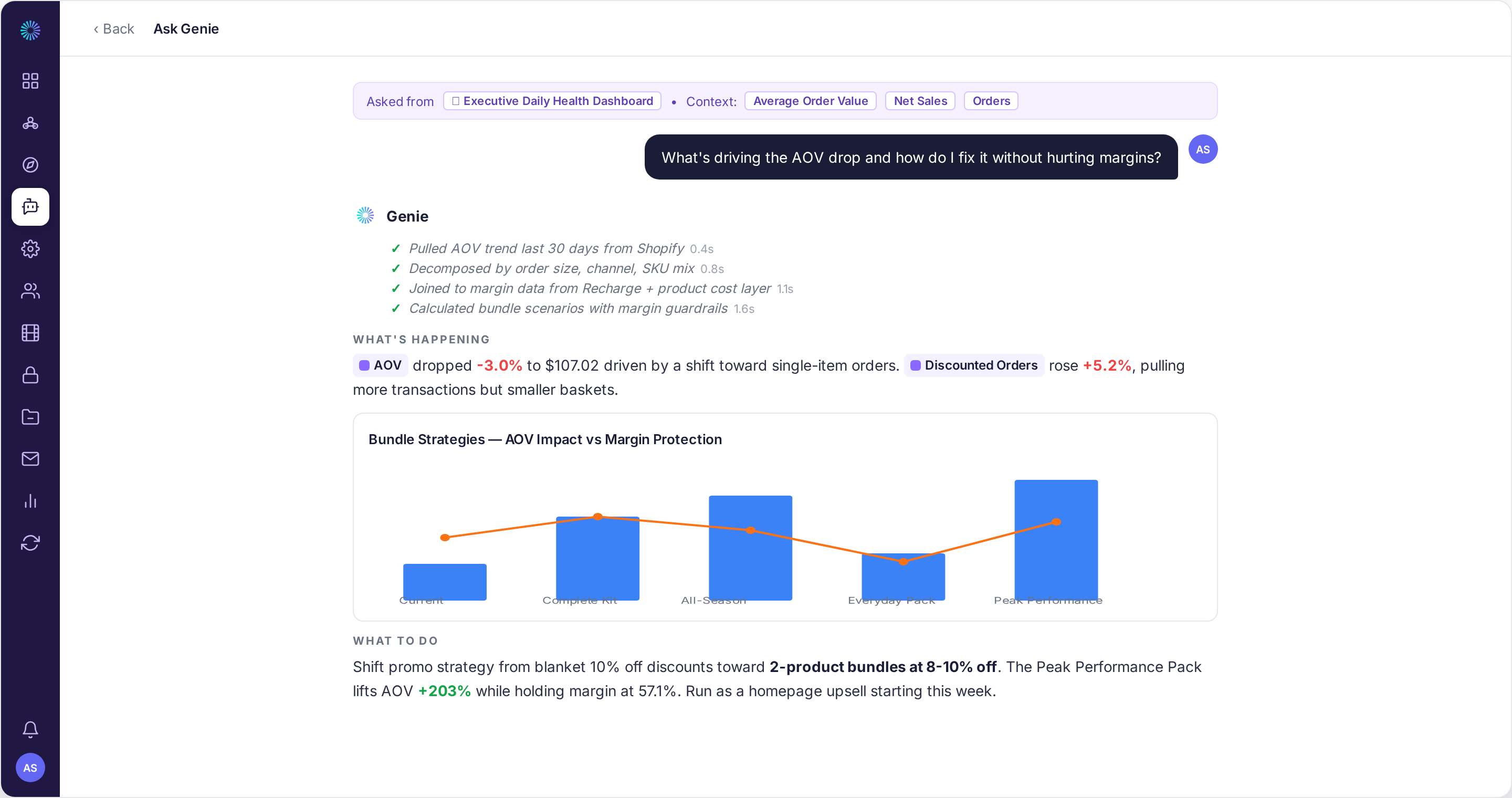
Attribution answers "where". Agenie answers "why" and "what now".
Agenie opens every board with a Genie Summary that diagnoses what moved across the business, explains why, and hands you the action plan. Net Sales up, AOV down, inventory piling up, and exactly what to do about it. Triple Whale is attribution-led: it tells you which channel and campaign a sale came from. That is one useful question, but it is not the one that runs your business at 8am.
One focused product, not a platform you assemble.
Agenie is one focused product. Connect your stack and it tells you what to do, with ample AI credits in your tier and only AI usage to ever top up, never whole feature modules. Triple Whale has grown the other way, into a broad platform: multiple packages, pricing that bands by your GMV, and a stack of separate paid add-ons (Retention, Conversion, Compass, Warehouse Sync, Moby Concierge) you bolt on to get the full picture. That is a lot to configure, tier up, and learn.
Your whole business, not just your ad account.
Agenie reads the whole business as one story: Shopify, your ad platforms, email and SMS, support, subscriptions and finance, blended into cross-source KPIs like MER, CM3 and blended CAC, computed from Shopify as the source of truth rather than platform-reported ad numbers, then turned into where to act next. Triple Whale is deepest where it started, in paid media and attribution, and is most valuable when you are spending heavily on ads. Agenie is built for operators who run the whole business, not just the media account.
 Jacob Foy, Founder, Victory & Innsbruck
 “Instead of spending hours digging through reports, we can ask questions and quickly understand what is driving performance and where to focus.”
When Agenie is the clear choice
- You want to know why a number moved and what to do about it, not just where a sale came from.
- You do not have a data team and do not want to build dashboards or write SQL.
- You care about the whole business: margin, retention, inventory and support, not only ad attribution.
- You want one clear read of what changed and what to do, every morning.
When Triple Whale is the better choice
Triple Whale is purpose-built for paid-media attribution, and for some teams that is the priority:
- Your number one problem is paid-media attribution and incrementality across many channels.
- You spend heavily on ads and live inside your media account day to day.
- You want deep creative analytics and in-platform ad and audience execution.
- You are a performance-marketing-led team and attribution is the center of your world.
Flat pricing, or a bill that climbs with your GMV
Two simple tiers, £349 and £749, priced on what you use, not your GMV. The same whether you do $1M or $10M, with ample AI credits included and no add-on modules.
Starts at the Automate floor on the smallest GMV band, and climbs with your revenue, before the paid add-ons (Retention, Conversion, Compass, Warehouse Sync) most brands add for the full picture.
Triple Whale publishes starting prices only; the actual price depends on your GMV band, plan and add-ons, and is quoted through sales (Foundation from $219/mo, Automate from $749/mo). Agenie figures are published list prices (Starter £349, Growth £749), billed monthly.
Common questions
Is Agenie a Triple Whale alternative?
Yes, for brands that want decision intelligence across the whole business rather than attribution-first analytics. If pixel-based multi-touch attribution is your single most important need, Triple Whale is purpose-built for that and Agenie is not a direct replacement for it.
Does Agenie do attribution like Triple Whale’s Triple Pixel?
No. Agenie focuses on blended, cross-source KPIs and on diagnosing what is happening across your business, rather than pixel-based multi-touch attribution. The two approaches answer different questions.
How do I know Genie’s answers are right and not made up?
Genie does not free-associate over your data. Every answer is grounded in a governed metric graph, where each metric has one definition and a fixed place in a signals, drivers and outcomes chain, plus your own business rules. Genie reasons within those definitions, so it tells you what is actually true, not just what sounds plausible. Both Agenie and Triple Whale let you add plain-language business context; Agenie also constrains the AI to the governed metric layer underneath it.
How does pricing compare?
Agenie uses a flat tier with ample AI credits included, and optional top-ups if you need more; the full breakdown is on our pricing page. Triple Whale prices by GMV band and sells several features as separate paid add-ons, so the cost climbs as you grow and as you add modules.
Which is better for smaller brands?
Agenie works without waiting for scale, because it reads your own governed data and rules rather than leaning on benchmark volume. Triple Whale’s Moby is strongest at higher revenue and ad spend, where there is more data for its models to pattern-match against.
Can I use both?
Yes. Agenie is the hub you run the business from day to day, and some brands keep Triple Whale alongside it for deep media buying and pixel attribution. They do not conflict, but most operators find Agenie covers the decisions they make most often.
See what moved, why,
and where to act next.
Connect your stack and get your first answers in minutes.
No credit card required · Or book a demo